

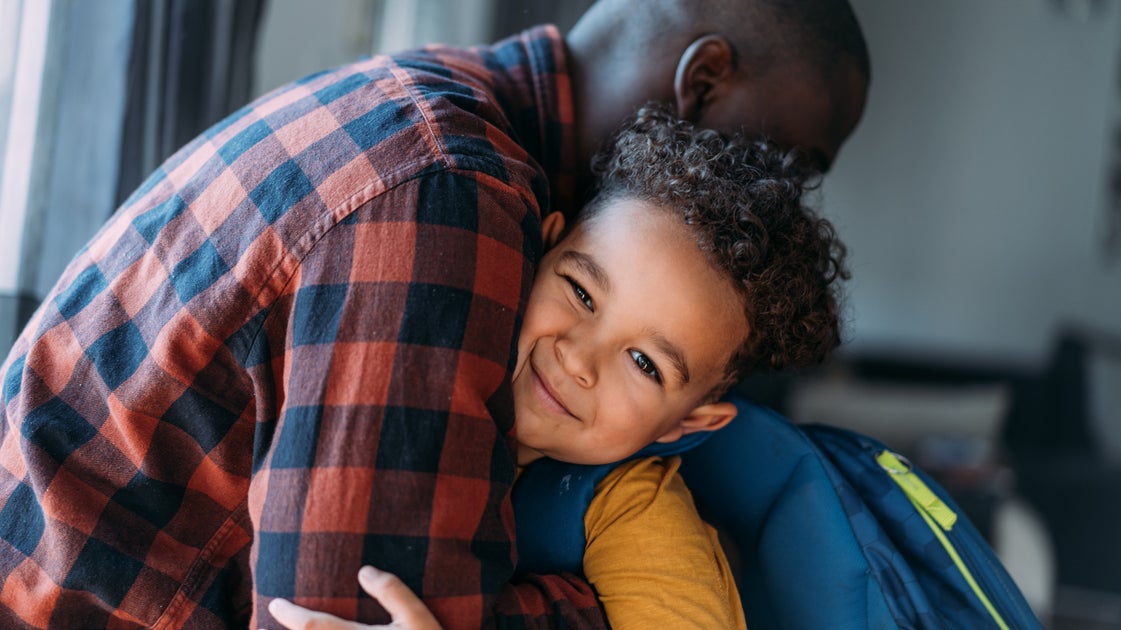
Every afternoon, parents attempt the same ritual. Backpacks are dropped, shoes kicked off, and as a child heads for the kitchen, they ask: “How was school?”
The response is nearly universal, short, clipped, unsatisfying: “Fine.” “Good.” Or even just a simple shrug.
It can feel like pulling teeth to get more than a one-word answer. Parents long to know what their child experienced in those six or seven hours away. What made them laugh, what challenged them, what stung and what made them proud. But for most kids, “How was school?” feels less like an invitation and more like a closed door.
“‘How was school?’ feels routine and generic, so children quickly learn to give equally routine answers like ‘fine’ or ‘OK,’” Michael G. Wetter, a board-certified clinical psychologist and diplomate of the American Board of Professional Psychology, told HuffPost. “For many kids, especially as they grow older, the question can feel like a conversation stopper rather than an invitation.”
SolStock via Getty Images
So what should parents do instead? Experts say it’s less about forcing a post-school debrief and more about creating ongoing opportunities for connection —through specific, open-ended questions, respectful timing, and genuine listening.
Here’s why the classic question falls flat, how to nurture conversations at different ages, and alternatives that might actually spark an answer.
Why ‘How Was School?’ Rarely Works
At first glance, the question seems harmless, even obvious. What parent wouldn’t ask about their child’s day?
The problem isn’t intention, but execution.
“The standard ‘How was school?’ often falls flat because it sounds more like what we call a ‘closed-ended’ question,” explained Joseph Laino, assistant director of clinical operations at Sunset Terrace Family Health Center at NYU Langone.
“Closed-ended questions can usually be answered with a monosyllabic response, something like ‘yes’ or ‘no’ or even ‘fine’ or ‘OK.’ Sometimes they’re met with a blank stare, a mumble, or a sarcastic retort. Closed-ended questions don’t invite the child to be more descriptive or expand upon what’s being asked.”
And sometimes, it’s not about the wording at all — it’s about timing and emotional bandwidth.
“Kids clam up when they feel pressured, overwhelmed, or unprepared,” said Carolina Estevez, a psychologist at Soba New Jersey, an addiction treatment center. “Right after school is often the worst time, because they’re mentally and emotionally drained from a full day of structure, rules, and social navigation.”
For children, school is an emotionally complex place. There may have been triumphs, a fun lunch, a good grade, a friendly exchange. But there may also have been moments of hurt or shame.
“The child may be trying to process these experiences and isn’t ready to share them yet,” adds Laino. “The less-than-positive experiences, in particular, may bring up feelings of shame, guilt, fear, or anger that the child isn’t sure they are ready to talk about.”
Why Specific Questions Work Better
Specificity helps kids focus and recall details. Instead of sifting through an entire day, they’re given a clear entry point.
“By narrowing the focus and inviting a story or feeling, these types of questions give children a clear starting point and show genuine interest,” Wetter said.
Reesa Morala, a family therapist, agreed: “Have a question that is thoughtful and direct, while making it hard to use the standard one-line responses. Some of these can be easily modified based on age.”
For example, instead of “How was school?” a parent might ask:
“What was one thing that brought you joy today?” or “What was the funniest thing that happened?”
These kinds of prompts encourage kids to answer with stories instead of single words.
Respecting Privacy While Staying Curious
The challenge grows as children become adolescents. They crave independence, and privacy becomes part of their developmental needs. Yet they still want connection, just on their terms.
“As children move into adolescence, their need for privacy grows right alongside their need for connection,” Wetter said. “The balance is delicate: if parents push too hard, kids can feel invaded and pull away; if parents step back too much, kids may feel disinterested or unsupported.”
The trick, experts say, is framing curiosity as care. Instead of demanding answers, try invitations: “Is it OK if I ask about how that group project is going?” or “I don’t need every detail, but I’d love to know a little about what your day was like.”
When kids decline, respect it. “Steer clear of guilting them or trying to convince them,” Morala said. “Simply show up: ‘I can respect that. If there are any ways I can support you, I’m in your corner, always.’”
That consistency matters. Adolescents learn over time that their parents’ curiosity isn’t about surveillance — it’s about love. And when they feel safe, they often volunteer more information.
Modeling Openness And Listening
It’s not just about asking questions; it’s also about how parents respond.
“Children learn how to communicate by watching how their parents communicate,” Wetter said. “When parents share snippets of their own day, frustrations, small victories, even silly mistakes, they show vulnerability and model that it’s safe to be real.”
Estevez agrees: “Sharing your own life first, briefly and honestly, signals vulnerability and makes sharing feel like a two-way street and not a one-sided quiz.”
“Right after school is often the worst time, because they’re mentally and emotionally drained from a full day of structure, rules, and social navigation.”
– Carolina Estevez, psychologist at Soba New Jersey
Listening well is just as critical. Parents often rush to problem-solve: “Well, maybe next time you should…”
But that can shut kids down. “A better stance is validation first,” Wetter said. “‘That sounds like it was really frustrating. I can see why you’d feel that way.’ By resisting the urge to fix, parents create an atmosphere of acceptance.”
Morala added: “Meet them where they are at. Use their language. If they say it ‘sucks,’ put yourself in their shoes and imagine what that must feel like.”
Reading The Signs
Sometimes, the question isn’t what to ask, but when to notice a child’s readiness.
“Signs a child wants to talk include lingering nearby, opening with small talk, unusual chattiness, or asking questions back,” Estevez said. “If you notice these, pause what you’re doing and follow their lead.”
Laino points out that children often drop “clues” when they’re ready: saying something like, “Something weird happened at lunch today.” That’s an opening worth following gently, with a phrase like, “Weird how?”
On the flip side, one-word answers, eye-rolling, retreating to their room, or earbuds-in are signals to wait.
“Avoid pressing them to respond,” Laino cautions. “It may make them feel cornered and cause them to shut down in response. Instead, you might say, ‘I get it. No pressure. If you want to talk later, I’m here for you.’”
Conversation Starters By Age
Here are some expert-backed prompts to try at different stages:
Elementary School (Ages 5–10)
“What was the funniest thing that happened today?”
“If your day was a color (or animal or emoji), what would it be?”
“Who did you sit with at lunch?”
“What was one thing that brought you joy today? What was one thing that bummed you out?”
“What did a friend say that made you smile?”
“What’s something you worked really hard on today?”
Bonus idea: Draw your day together. “No questions needed — just draw,” Laino said. “It can open doors you wouldn’t get otherwise.”
Middle School (Ages 11–13)
“What was something that surprised you today?”
“Who did you hang out with at lunch?”
“What teacher is passing the vibe check?”
“If you could redo one part of today, what would it be?”
“What song best describes how today was?”
“What’s something you worked on in class that made you think hard?”
“What was the most interesting conversation you had today?”
High School (Ages 14–18)
“What’s something today that made you feel proud — or frustrated?”
“What friend had your back this week?”
“What class gave you something to think about?”
“Who do you admire at school right now and why?”
“What’s one thing you’re excited for this week? What’s one thing you’re low-key dreading?”
“What conversation stuck with you most today?”
“What was the highlight of your day and the hardest part of your day?”
Yes, Your Mileage May Vary — But Showing Up Makes A Difference
“When kids feel your curiosity is genuine and not a quiz, they’re far more likely to share — and even enjoy it,” Estevez said.
Ultimately, conversation is less about the right question and more about the right posture. By showing up with patience, presence and respect, parents can turn small exchanges into lasting connections, sometimes with nothing more than a simple, thoughtful question.