

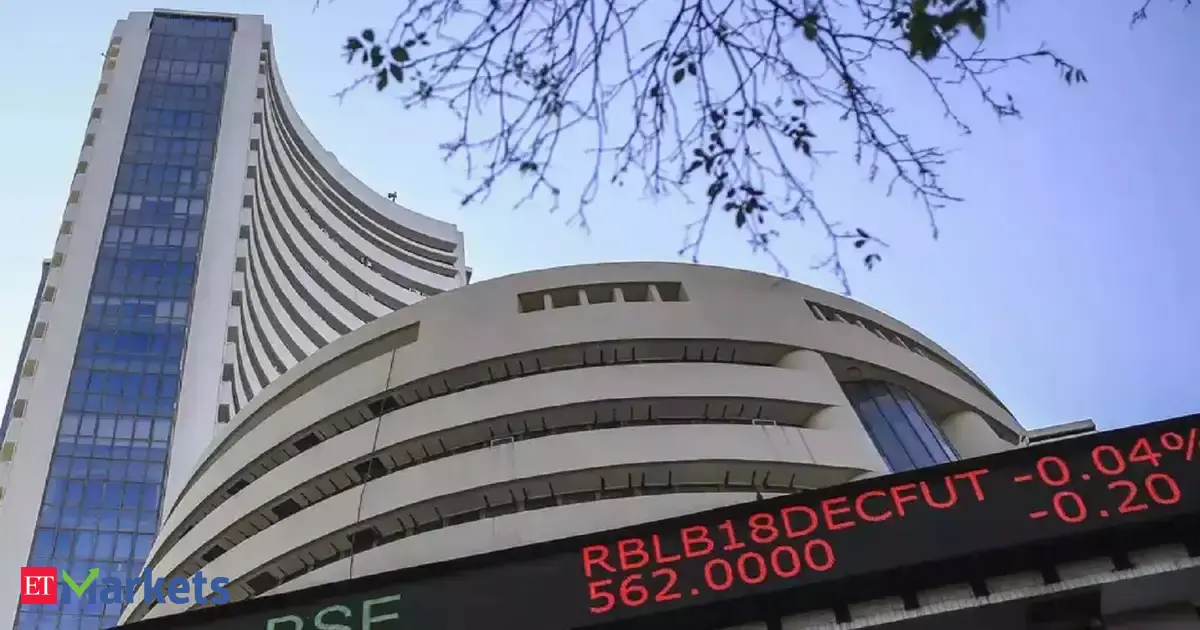
At around 9:20 am, the BSE Sensex was down 175 points, or 0.22%, at 81,010, while the Nifty50 declined 43 points, or 0.17%, to 24,723.
On Thursday, both indices had fallen as much as 0.9% during the session but trimmed losses to end 0.4% lower. Investors largely viewed the tariff announcement as a pressure tactic by the U.S. and remained hopeful of a resolution through ongoing negotiations.
U.S. President Donald Trump confirmed on Wednesday that talks with India are continuing, shortly after announcing the tariffs.
In addition to India, the U.S. also raised tariffs to 35% from 25% on imports from Canada and imposed duties of 20% and 19% on Taiwan and Thailand, respectively.
Meanwhile, within the Sensex pack, Sun Pharma, M&M, Tata Steel, Tata Motors, Infosys, and L&T opened in the red, while HUL, ITC, Asian Paints, Kotak Mahindra Bank, Trent, and Bajaj Finance saw early gains.Sun Pharma dropped nearly 5% in early trade after the drugmaker reported a 20% year-on-year decline in consolidated net profit to Rs 2,278 crore for Q1FY26, down from Rs 2,836 crore in the same quarter last year.On the sectoral front, Nifty FMCG rose 1.4%, led by HUL, whose shares jumped nearly 4% after the company reported a 7.6% year-on-year increase in standalone net profit to Rs 2,732 crore for Q1, up from Rs 2,538 crore a year ago. Meanwhile, Nifty Auto, IT, Metal, and Pharma indices declined between 0.4% and 2.7%.
Experts View
“The August series starts on a weak note after the 3.1% dip in Nifty in July. In the near-term the market will be influenced by the tariff-related news. Since the date of implementation of the modified tariff rates is August 7th, that gives countries time to negotiate and bring the tariffs down. That may happen,” said Dr. VK Vijayakumar, Chief Investment Strategist, Geojit Investments.
“An important trend in the market is the weakness in the broader market, particularly the smallcaps. This trend is likely to continue given the high valuations of the segment. Sustained selling by the FIIs continues to be a negative. The sharp surge in the dollar index to 100 will nudge the FIIs to continue selling putting pressure on largecaps too. Investors can adopt a wait and watch strategy,” Vijayakumar added.
Hardik Matalia, Derivative Analyst at Choice Broking, said, “Nifty remains vulnerable unless it sustains a move above the 24,800 mark. A close above this level could potentially open the path toward the 25,000 level. On the downside, immediate support is located at 24,600, followed by 24,500—both of which may offer buying opportunities on dips.”
Global Markets
Asian shares fell on Friday after the U.S. slapped dozens of trading partners with steep tariffs, while investors anxiously await U.S. jobs data that could make or break the case for a Fed rate cut next month.
MSCI’s broadest index of Asia-Pacific shares outside Japan fell 0.7%, bringing the total loss this week to 1.8%. South Korea’s KOSPI plunged 3% while Taiwanese shares fell 0.9%.
Japan’s Nikkei dropped 0.4%. Chinese blue chips were flat and Hong Kong’s Hang Seng index eked out a small gain of 0.2%.
EUROSTOXX 50 futures slipped 0.2%. Both Nasdaq futures and S&P 500 futures eased 0.2% after earnings from Amazon failed to live up to lofty expectations, sending its shares tumbling 6.6% after hours.
FII/DII Tracker
Foreign Institutional Investors (FIIs) extended their selling streak for the ninth consecutive session on July 31, offloading equities worth Rs 5,588 crore. In contrast, Domestic Institutional Investors (DIIs) remained net buyers for the 19th straight session, investing Rs 6,372 crore into the market.