

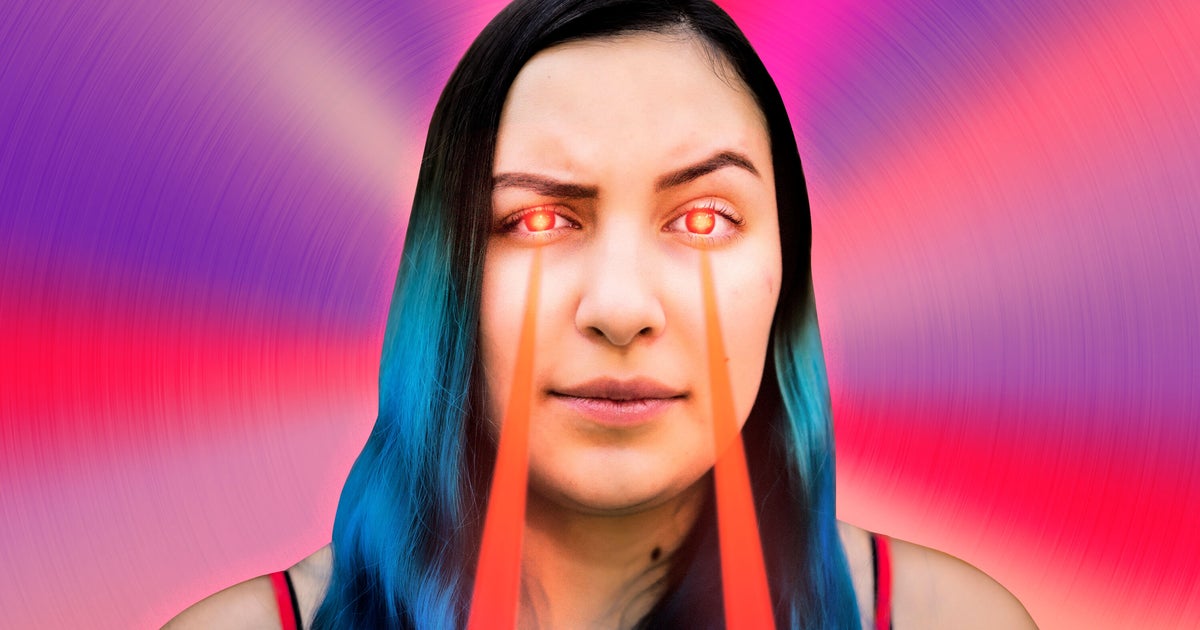
Do you feel eyes staring at you right now? It might just be Gen Z.
On TikTok, people have coined the “Gen Z stare” as a way to describe the eerie, blank stare that the generation born between 1997 and 2012 often offers up to strangers they meet. Instead of a customary greeting, these young people do the opposite. They don’t react and stay silent to whatever you might be saying.
Generational divides over what is considered polite or helpful are not new, but this trend in particular has struck a nerve with people who are sure they are naming a real, peculiar phenomenon.
Lanie Beams, who lives Nashville, Tennessee, said she got this stare every day when she worked the floor of a boutique and behind the front desk of a gym.
“The Gen Z stare to me is when you are approaching someone and just trying to do your job and make a conversation, or you’re meeting someone for the first time and you introduce yourself to say ‘Hi,’ and you get just no response back,” Beams said. “It’s just a blank stare with no words. And then you’re like, ‘Did I say something wrong?’“
Beams, who is 25 and also Gen Z, said she believes this non-response is rude. When she got it from her fellow zoomers, she would think, “Hello, open your mouth. I can’t understand you, stop staring at me.”
But not everyone is a critic. In fact, other young people said the Gen Z stare is nothing to be ashamed of, and is, in fact, an appropriate response to the world they encounter.
Critics say it’s rude, but Gen Z defends the ‘Gen Z stare’ as strategic.
Karli Mayer, a 25-year-old dental hygiene student in Denver, Colorado, said she will unleash her “Gen Z stare” when something weird, unexpected, or a little “cringe” happens, or when she cannot hear exactly what was said.
“People assume it’s about being disengaged, but it’s actually the opposite. We’re very aware and observant, maybe too much sometimes,” she shared. “The stare is our way of setting boundaries or reacting without over-explaining ourselves. It’s a quiet form of communication that’s more subtle and emotionally controlled than older generations are used to.”
For 24-year-old London bartender Jordan MacIsaac, her “Gen Z stare” is a defense mechanism against agitating drunk customers. “All you can really do is stare at them when you know you can’t say anything that’ll lose you your job, she said. “I’m a young female bartender. There’s a lot of people hitting on me and I try not to engage with that at all.“
However, for MacIsaac, when the tables are turned and she is a customer, she makes sure to show emotion and be talkative.
“I think across all ages, people can recognize that minimum-wage jobs can really not be the most fun,” she said.
The unnerving Gen Z stare may also be unintentional.
So, yes, there are young people who stare on purpose for a variety of reasons, but there are also people who might be doing it accidentally.
Gen Z is unique for being the first generation to grow up chronically online with social media ― as well as a pandemic that forced people to do schooling and first jobs remotely.
“Being in those developmental stages of life and… being locked inside could have also maybe had an effect on it,” Beams suggested.
MacIsaac said that entering the workforce when people wore masks and you didn’t “have to worry about the bottom half of your face” also may have played a role in developing her “Gen Z” stare.
Denise Dudley, a psychologist and behavioral expert, said she has seen Gen Z staring in action and believes it’s usually not intentional. Although some people may do it to subtly punish others for speaking to them, it’s likely due to a lack of social skills.
Because of COVID, “they have a gap in how they actually learn how to interact with people, in particular, how to make eye contact, nod, look like they’re listening, give a little bit back in the conversation, so that we know they’re with us,” Dudley said.
She cautioned that if you want to impress anyone you meet, you need to be nodding and talking back, though.
“Dismissing somebody out of hand, just because you didn’t feel like engaging with them, or you felt like acting superior, or you felt like I’m not obligated to respond to you, it could definitely bite you ― that’s the downside,” she said.
“You do not know who you’re going to talk to and how they [might] change your life. And it could be anyone,” Dudley continued.
But whether you love or hate what’s being communicated, know that the Gen Z stare is not a blank look ― it has weight and meaning.
“There’s a lot of things in my mind that I maybe want to say that I know I can’t,” MacIsaac said. In fact, a whole conversation might be communicated in that one look.
“It’s not meant to offend,” Mayer said. “It’s just a modern way of saying, ‘I see what’s happening, and I’m not impressed.’”